Migrant workers train on citizen journalism and digital literacy
9/26/20252 min read
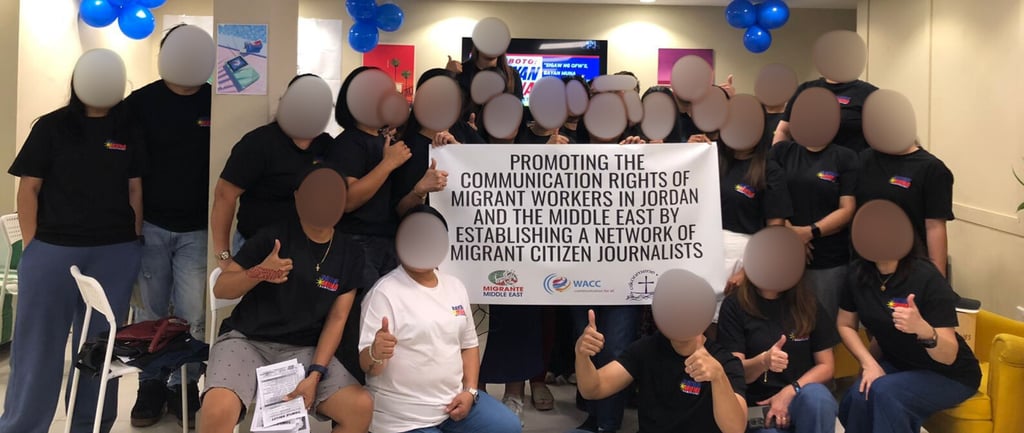

For the past month, Migrante Middle East has spearheaded a series of trainings and discussions on citizen journalism and digital literacy with Filipino migrant workers. Participants came from Jordan, the United Arab Emirates, Saudi Arabia, and Israel.
This series builds on the discussions Migrante Middle East has held over the past months with other Filipino migrant organizations in the region. Those earlier dialogues highlighted the need to train, develop, and empower citizen journalists among Filipino migrant workers. They also confirmed that mobile citizen journalism is both timely and relevant for raising awareness of the plight of migrant workers.
Digital literacy session
Migrant workers rely on digital services to stay in touch with their families and send remittances home. Yet many are vulnerable to digital attacks, primarily scams and invasions of their privacy. This highlighted the importance for migrant workers and their organizations to develop a deeper understanding of the digital foundational skills needed for daily life, work, and safety.
The discussions on digital literacy included hands-on operation of smartphones and computers, navigation of public services and online banking, understanding internet safety and privacy, and most of all, effective communication tools to stay connected with family, community, and the world.
Internet safety and privacy were underscored in relation to building citizen journalists among migrant workers who will expose the conditions of migrant workers in Jordan and in the Middle East to society and the world. Participants agreed that unpacking these conditions, whether of Filipino migrants or of other nationalities, will also uncover the social ills and power relations that create them. Therefore, safety and privacy and critical concerns when operating a network of citizen journalists.
Mobile citizen journalism training
The session on citizen journalism focused on its potential as a tool to enhance community involvement, engagement, and impact. The main content of the training included how to transform simple storytelling using mobile phones into thought-provoking migrant community news. It also included discussions on the principles of journalism ethics along with verification of sources and information, how to use simple equipment required to produce quality reports, pre-production activities, actual production, what goes into post-production, and simple techniques for sound and picture/shot composition. The training workshop ran in a hybrid mode by combining online resource persons and an on-site trainer to guide the workshops. Participants were divided into smaller groups and given 30 minutes to produce news or a feature story using their phones.
The breakout groups were able to produce a range of news pieces and feature stories on migrant-related issues in Jordan and other parts of the Middle East which they presented to the plenary. The narrative design of reports produced during the training can be improved through regular practice. Other skills that need further improvement include interviewing skills, familiarity with other formats other than Facebook, and tactics on how to improve audience engagement.
The training adopted a strength‑based, bilingual approach, building on participants’ existing experiences and skills. Both on‑site and online attendees actively asked questions and offered examples relevant to their own experiences.
Given the significance of (mobile) citizen journalism in the advocacy work of Filipino migrants in Jordan and other parts of the Middle East, participants raised the need to recognize misleading online information and fake news. Several participants also stressed the importance of acquiring crucial knowledge and skills to counter misinformation and disinformation, laying the basis for deeper future discussions.
Overall, the combined training demonstrated that citizen journalists can effectively use mobile tools to give a voice to marginalized or under-reported migrant issues in Jordan and in the Middle East. Participants left convinced that digital storytelling of their (migrant) issues can foster a two-way communication with their audience, facilitate civil discourse, and inspire participatory action that helps distressed migrant workers and mobilizes support.